Options
Fluorescence Analysis of a Plate Sample from a Plasma Panel Display
Accessories
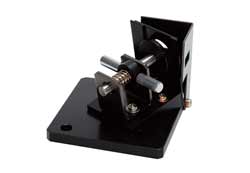
Solid sample holder 650-0161
An example of measuring fluorescence spectra of a plasma panel display using a solid sample holder.
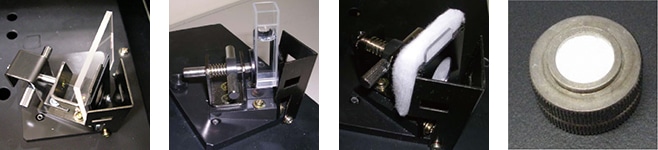
Example of setting up sample
3-D Fluorescence Spectra
The figure shows results of a 3-D measurement on a plasma display panel. On each excitation wavelength, blue, green, and red spectra are observed. The F-7000 series featuring a high scanning speed can obtain the data shown on the right in as little as 1.5 minutes.
3-D assay presents a great deal of information from a single sample preparation process, thus reducing the amount of time required to run measurements. The ultra-high speed scanning of the F-7000 series can be a powerful tool for the measurement of samples that change with time.
Excitation and Fluorescence Spectra
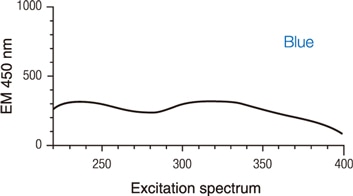
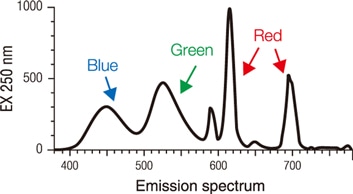
Results of a 3-D measurement can also be represented in 2-D data. The graphs below show excitation and emission spectra of a plasma display.
It presents spectra at specific wavelengths. By using the blue, green, red spectra data represented in 2-D, the technique can be applied to the measurement of fluorescent colors (fluorescence chromaticity coordinates).
Window for fluorescence intensity standardization
Window for fluorescence intensity standardization
Removing secondary light
Accessories
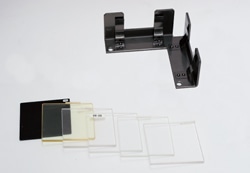
Filter set 5J0-0151
In surface light measurements, multi-order light, including second-order light, that is produced by light scattering interferes with the measurement. An effective tool for removing multi-order light is a cut filter. Fluorescence is based on the principles of Stokes, which can be observed at longer wavelengths than the excitation light.
Effects of a cut filter
The graphs below show the effects of using a cut filter based on sodium salicylic acid (powder) data. The filter (WG320) cuts the scattered light that would otherwise enter the detector and suppresses the occurrence of second-order light.
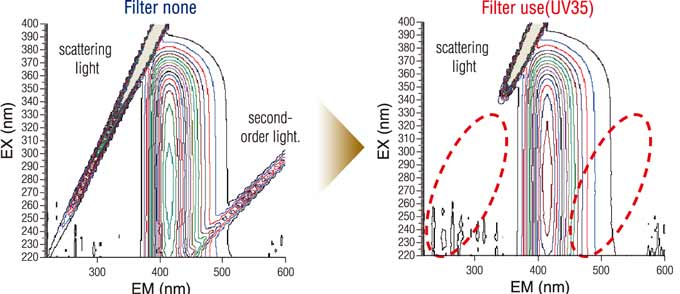
The following graphs also show data that are extracted from third-order data. It is clear that the occurrence of second-order light that is duplicate to the spectra is also suppressed on the second-order data.
Microplate accessory
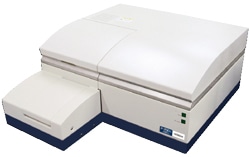
Micro Plate Reader 5J0-0139*1
The microplate accessory permits the direct assaying using the F-7000 of a sample applied to a microplate.
The accessory lends itself to automation for assaying as a microplate reader or an auto-sampler based upon the use of microplates.
| Compatible microplate | 96 well wells (400 µL, flat bottom) |
|---|
| Measuring speed | 96 wells/60 s (in kinetics measurement mode) |
|---|
| Thermostatic function | Thermostatic water bath connectable 5 to 60 °C
(Thermostatic water bath separately available) |
|---|
- *1
- Compatible microplates are commercially available ones having 96 wells.
Background fluorescence level may be high depending on a selected microplate.
Features of the microplate accessory
- Effective for the assaying of multi-specimen samples : compatible with 96-well microplates
- High-sensitivity assaying : Detection sensitivity : 5×10-11 mol/L (fluorescein)
- High-throughput assaying : 96 wells/60 seconds
- Wide dynamic range : 6 digits or higher
Example of PicoGreen® assay
The PicoGreen® can assay double-strand DNA, specifically and in high sensitivity, in a manner immune to the effects of RNA, single-strand DNA or proteins present in the sample. As such, the system is well-suited for the assaying of template amount in a DNA sequencer or PCR.
The use of the microplate accessory supports high-throughput measurement operations.
System for measurement under constant temperature - Measurement of green fluorescent protein (GFP)
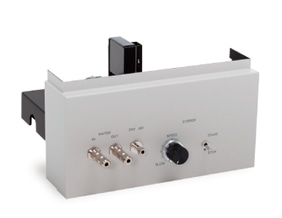
Thermostatted cell holder with stirrer 250-0346
Micro cell 650-0116
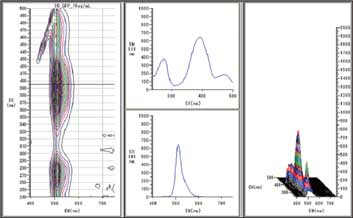
Three dimensional fluorescence spectra of GFP
Typically, an increase in the temperature of a sample by 1°C causes a decrease in its fluorescence intensity by 1 to 2%. In addition, in the biological field, samples are measured in a similar condition to in vivo environment.
Highly temperature-dependent samples and biological specimens should be measured under constant temperature using a thermostat cell holder.
The example shown here displays the fluorescence properties of green fluorescent protein (GFP). GFP is a fluorescent protein existing in Aequorea victoria, which is essential for measurements of intermolecular interactions (FRET, BRET), bioimaging studies, etc.
We measured the 3-D fluorescence spectra of GFP using the microcell with a stirrer. Since the sample solution is stirred with a magnetic stirring bar, measurements can be conducted with a greater accuracy in temperature.
- * We have wealth of other optional accessories.
