Features
World-class baseline repeatability
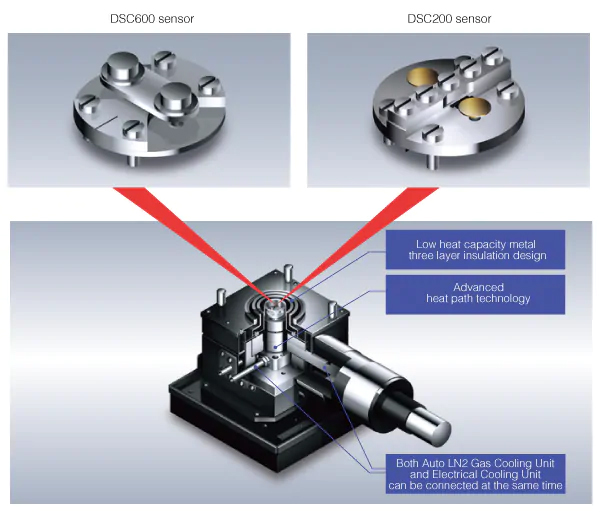
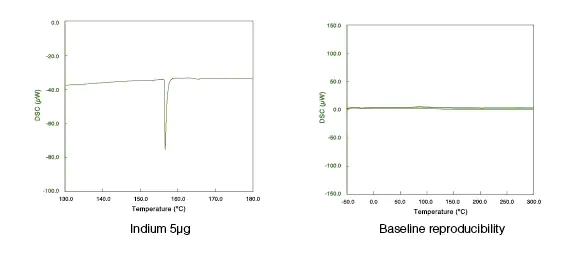
Both NEXTA DSC600 and DSC200 use a centric heat-flow design in the sensor. This allows the heat from the heat sink transferred evenly to the sample and the reference, resulting in the high baseline stability. Also using a furnace structure with a low-heat-capacity three-layer insulation design, NEXTA DSC achieves world-class baseline repeatability and stability.
World-class sensitibity
The NEXTA DSC600 has our own proprietary thermopile-type DSC sensor built in, using differential scanning calorimetry (DSC signal) temperature sensor thermocouples connected in series and multiplexed (a thermopile) to achieve a high sensitivity of 0.1 µW or lower, enabling measurement of even smaller samples.
Wider temperature range for Real View® DSC
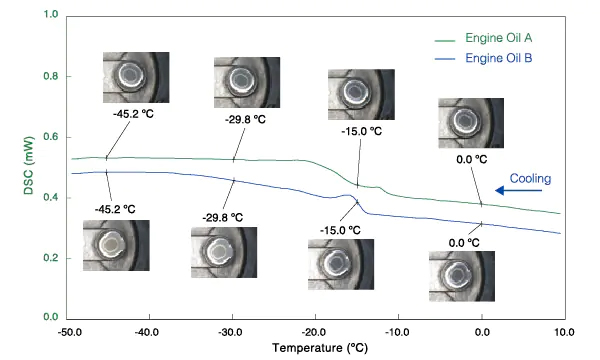
The Real View Sample Observation Unit has a built-in two-megapixel high-resolution camera that supports localized observation within a sample. The viewport (observation window) has a heating mechanism that extends the measurement range from the conventionally observable range of room temperature and above down to the low temperature of -50℃. This enables you to observe processes such as the melting and glass transition of samples at low temperatures, supporting a wide range of measurement needs
Specific heat capacity determination by temperature modulated DSC method
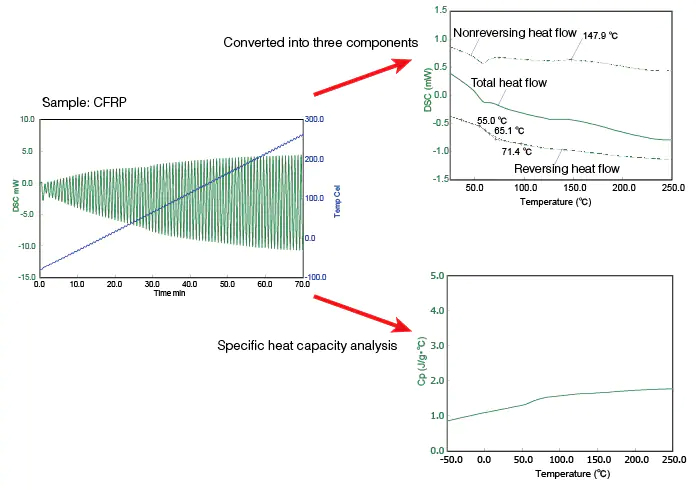
The reversing heat flow(e.g. glass transition) and non-reversing heat flow(e.g. enthalpy relaxation, curing, evaporation, decomposition) can be separately obtained from a single modulated DSC measurement, and it is useful when these transitions or reactions overlap. With NEXTA DSC, the modulated DSC method can also be used for determining the specific heat capacity.