Features
Schottky SEM with large specimen chamber to expand application capabilities
Evaluating shapes by electron microscopy is the foundation of all material evaluation and analysis. Demand has always existed for the ability to mount and observe specimens in their original shape.
The SU3900SE/SU3800SE Series Microscopes have a highly rigid multipurpose specimen chamber that makes it possible to mount specimens as is.
This eliminates the need to perform metal coating of non-conductive specimens and breaking or cutting large and heavy specimens, allowing observation from a wide variety of angles.
High resolution for improved top-surface imaging
The resolution has been improved at both high and low accelerating voltages by adopting a newly developed Schottky electron gun. An advanced model (SE Plus) is also available to meet the demand for fine observation of top surface detail.
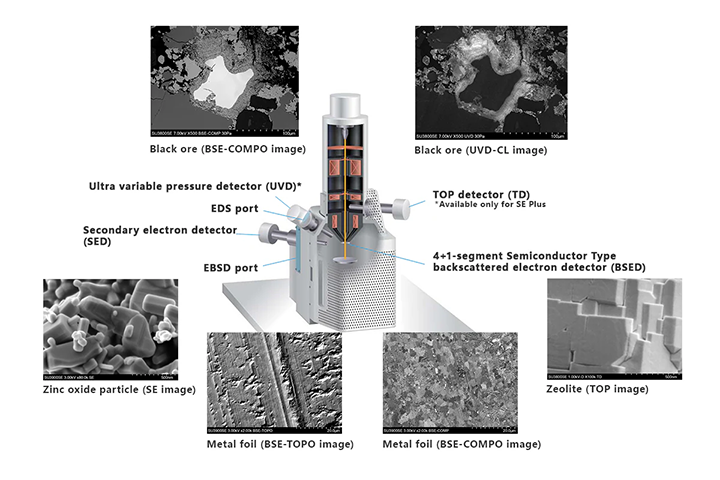
Furthermore, a low-accelerating-voltage high-sensitivity backscattered electron detector is included for obtaining composition and topographic information.
This makes it possible to perform a multifaceted analysis through acquisition of a wide range of information when combined with the optional ultra-variable-pressure detector (UVD).
Automation and support functions that improve usability
The SU3900SE/SU3800SE Series Microscopes are equipped with an automatic optical adjustment function that reduces manual work. This auto alignment sequence function eliminates the need to manually adjust the beam alignment, aperture alignment, focus, and stigmation. In addition, the EM Flow Creator is available to support automation of operations such as sequential image capture. A series of observation recipes can be created by setting parameters such as magnification, stage position, focus, and contrast adjustment, into blocks that can be combined, thus allowing the creation of customized recipes. Recipes can be created by dragging and dropping blocks into an arrangement like a flowchart. Automatic observation is possible by executing a created recipe.
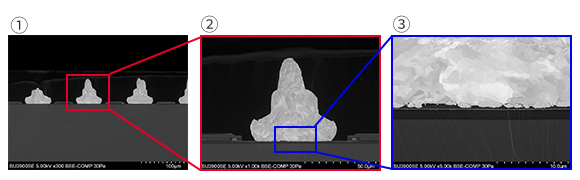
① Locate the area of interest and capture an image at x300.
② Execute the template matching function on image ① to locate a new area of interest. Then center on the location, zoom in, and capture an image at x1,000.
③ Execute the template matching function on image ② to locate a new area of interest. Then center on the location, zoom in, and capture an image at x5,000.
